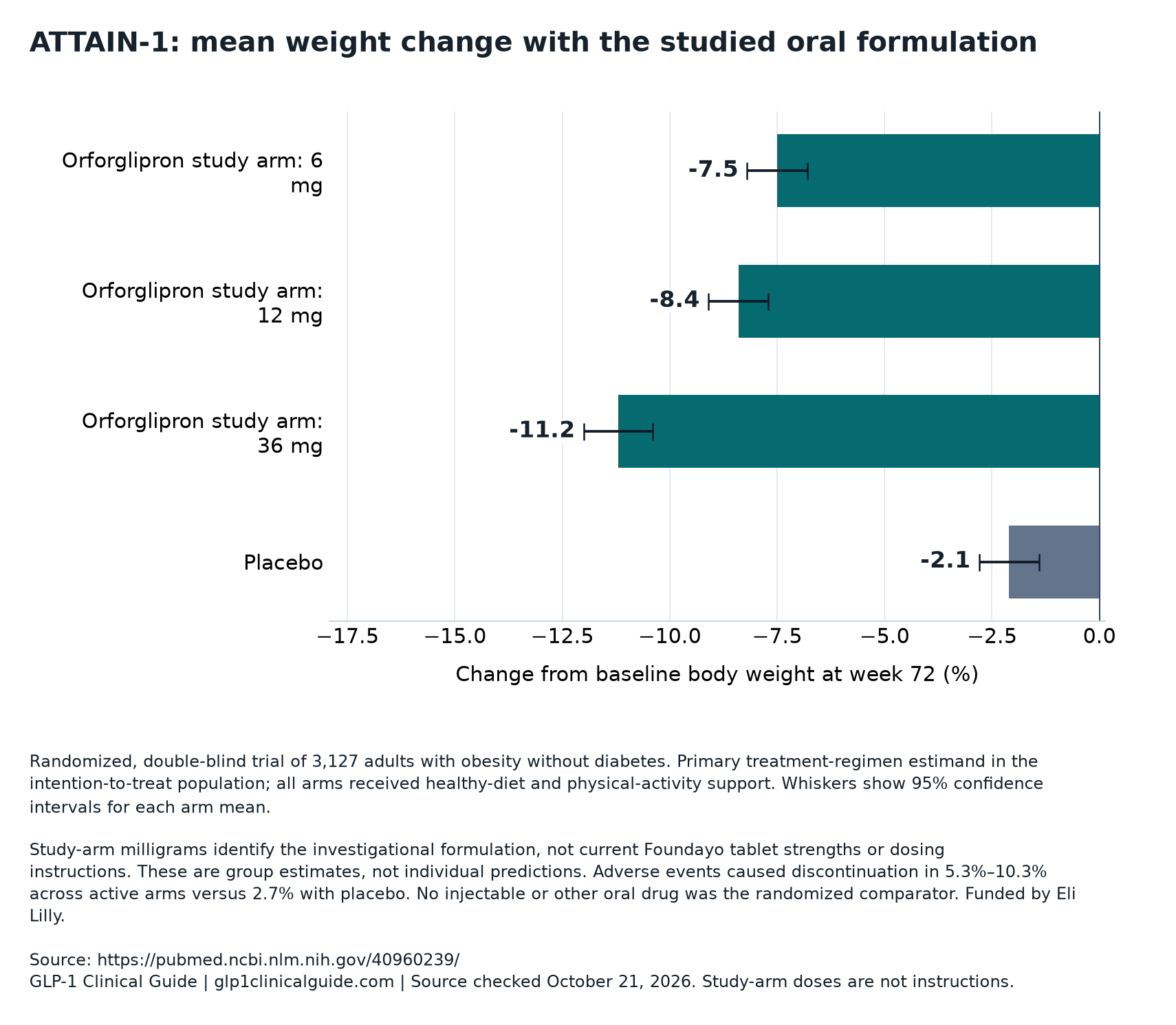
ATTAIN-1 offers a substantial answer to a specific clinical question: how much did body weight change over 72 weeks when adults without diabetes were assigned to daily oral orforglipron rather than placebo, alongside diet and physical activity support? In the indexed primary report, average weight reduction reached 11.2% in the highest-dose study arm, compared with 2.1% with placebo. That result is neither a prediction for every patient nor evidence that one care platform delivers those outcomes.
The distinction between the research product and the marketed medicine also matters. Foundayo, the brand name for orforglipron, received initial US approval in 2026. ATTAIN-1 used an investigational formulation whose milligram amounts are not interchangeable with current tablet strengths. This analysis uses the indexed primary research abstracts and available official labeling and FDA material; it does not assume access to every trial protocol, supplement, or full research article.
ATTAIN-1: mean weight change with the studied oral formulation
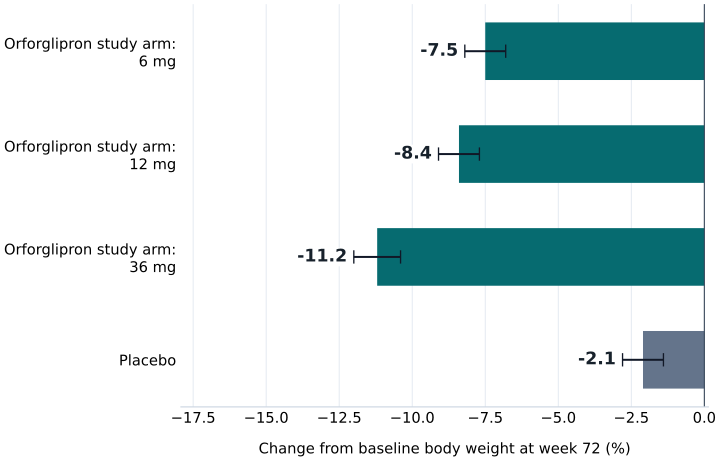
Randomized, double-blind trial of 3,127 adults with obesity without diabetes. Primary treatment-regimen estimand in the intention-to-treat population; all arms received healthy-diet and physical-activity support. Whiskers show 95% confidence intervals for each arm mean.
Study-arm milligrams identify the investigational formulation, not current Foundayo tablet strengths or dosing instructions. These are group estimates, not individual predictions. Adverse events caused discontinuation in 5.3%–10.3% across active arms versus 2.7% with placebo. No injectable or other oral drug was the randomized comparator. Funded by Eli Lilly.
Source 1Download the source-labeled chart (PNG) · Download the data (CSV)
| Study group | Reported value | 95% confidence interval |
|---|---|---|
| Orforglipron study arm: 6 mg | -7.5 | -8.2 to -6.8 |
| Orforglipron study arm: 12 mg | -8.4 | -9.1 to -7.7 |
| Orforglipron study arm: 36 mg | -11.2 | -12.0 to -10.4 |
| Placebo | -2.1 | -2.8 to -1.4 |
Sections in this article
Randomization tested a treatment strategy, not a pill in isolation
ATTAIN-1 was a phase 3, multinational, randomized, double-blind trial funded by Eli Lilly. Participants were assigned in a 3:3:3:4 ratio to investigational orforglipron doses of 6 mg, 12 mg, or 36 mg, or placebo. Double-blind means treatment assignments were concealed from participants and investigators during the blinded trial. The larger placebo allocation provided a shared comparison group for all three active arms.
Each group received the assigned daily oral treatment alongside healthy-diet and physical-activity support. The comparison therefore estimates the additional effect of assignment to orforglipron within that supported setting. It does not compare medication with doing nothing, or show what the same medicine would achieve without follow-up and lifestyle intervention.
The prespecified primary endpoint was percentage change in body weight from baseline to week 72. That timing matters: the reported average summarizes a long treatment period, not an early response. Randomization strengthens causal interpretation within the study population, but does not turn a group average into an individual forecast.
Source 1Participant selection defines where the evidence fits
The abstract describes adults with obesity without diabetes. The official label provides more detailed eligibility for the same registered trial: BMI of at least 30, or BMI from 27 to below 30 with at least one weight-related condition. BMI is weight relative to height, not a direct measurement of body fat or its distribution. Type 2 diabetes was excluded.
According to the label, participants had a mean age of 45 years, with ages ranging from 18 to 88; 64% were female. Mean baseline weight was 103.2 kg and mean BMI was 37. Hypertension affected 40%, dyslipidemia 39%, and obstructive sleep apnea 11%. These details locate the result in a population with substantial weight-related health needs rather than a general population seeking modest weight changes.
The trial alone cannot establish the corresponding average response in people with diabetes, children, or every older-adult subgroup. The label describes a separate diabetes trial, which should not be folded into ATTAIN-1. The guide to what clinical eligibility means provides a useful framework for separating research enrollment from an individual clinical assessment.
Source 1 Source 2The primary analysis asks what happens after treatment assignment
An estimand is the precisely defined treatment effect a study aims to estimate. ATTAIN-1’s primary result used a treatment-regimen estimand in the intention-to-treat population. In plain language, the question centers on assignment to the treatment strategy, rather than restricting the answer to people who remained on treatment throughout.
That distinction is consequential when treatment is discontinued. An efficacy analysis focused on continued treatment addresses a different question and can yield a different average. The primary-report figure to use here is 11.2% in the highest-dose investigational arm. A larger efficacy-estimand headline is not a substitute for that primary treatment-regimen estimate.
Intention-to-treat does not mean every final weight was directly observed. The label reports missing week-72 weight endpoints in 24% of placebo participants and 14%–16% across active arms. It describes multiple imputation, a statistical procedure that fills missing values using specified data-based assumptions. Randomization protects the original comparison, but missing-data assumptions still influence the estimated endpoint.
Source 1 Source 2Reading the weight changes without confusing percent and percentage points
All three active arms had significantly greater mean weight reductions than placebo in the primary abstract. The confidence intervals below describe uncertainty around each estimated group mean. They do not describe the range of weight changes experienced by 95% of individual participants.
Subtracting the placebo mean gives additional reductions of 5.4, 6.3, and 9.1 percentage points for the three investigational arms. Those are arithmetic contrasts calculated from the abstract’s rounded means, not separately reported confidence intervals for treatment differences. For a hypothetical 100-kg starting weight, an 11.2% reduction corresponds to 11.2 kg; actual participants started at different weights and had varied responses.
The label reports slightly different primary-analysis values, including −11.1% for its highest equivalent marketed-dosage arm rather than the abstract’s −11.2%. It also presents its analysis and missing-data method. These small reporting differences should remain attached to their respective sources rather than being combined into a seemingly more precise result.
| Investigational study arm | Mean weight change (95% CI) | Additional reduction versus placebo |
|---|---|---|
| Orforglipron 6 mg daily | −7.5% (−8.2% to −6.8%) | 5.4 percentage points |
| Orforglipron 12 mg daily | −8.4% (−9.1% to −7.7%) | 6.3 percentage points |
| Orforglipron 36 mg daily | −11.2% (−12.0% to −10.4%) | 9.1 percentage points |
| Placebo daily | −2.1% (−2.8% to −1.4%) | Reference group |
Responder thresholds reveal variation hidden by the mean
The average is only one way to summarize weight loss. In the highest-dose investigational arm, 54.6% reached at least 10% reduction, 36.0% reached at least 15%, and 18.4% reached at least 20%. Corresponding placebo proportions were 12.9%, 5.9%, and 2.8%. These results show that substantial reductions occurred more frequently with treatment, without implying that everyone achieved them.
The thresholds overlap. A participant losing 22% qualifies for all three categories, so adding the percentages would count some people repeatedly. As an arithmetic interpretation, subtracting 36.0% from 54.6% suggests 18.6% fell between the 10% threshold and below 15%, subject to rounding and the underlying analysis. Thresholds are not separate, mutually exclusive treatment outcomes.
They also answer a different question from the mean: how often did participants reach a chosen level? The absolute between-group gaps were 41.7, 30.1, and 15.6 percentage points for the three thresholds. These response gaps are not relative risk reductions, and they do not identify who will respond before treatment begins.
Source 1Improvements in risk markers are not cardiovascular outcome evidence
The primary abstract reports improvements versus placebo in waist circumference, systolic blood pressure, triglycerides, and non-HDL cholesterol. These measures add clinical context to the weight endpoint: waist circumference describes body size, systolic pressure is the upper blood-pressure reading, and triglycerides and non-HDL cholesterol describe blood lipids.
The official label quantifies some contrasts. In the highest equivalent marketed-dosage arm of the trial without diabetes, waist circumference changed by −10.0 cm versus −3.1 cm with placebo, a reported difference of −6.9 cm (95% CI, −7.8 to −6.0). Systolic pressure differed by −4.9 mm Hg (95% CI, −6.1 to −3.8). The label flags that blood-pressure comparison as not controlled for multiplicity, meaning it lacks the same protection against false-positive findings across many tests.
These are intermediate measurements, not proof of fewer heart attacks, strokes, or deaths in ATTAIN-1. The distinction parallels the endpoint questions explored in the ESSENCE liver-evidence analysis: improvement in a measured disease marker and improvement in later clinical events are related but separate scientific claims.
Source 1 Source 2Treatment discontinuation is a central part of the result
Adverse events caused treatment discontinuation in 5.3%–10.3% across ATTAIN-1’s active arms, compared with 2.7% with placebo. The abstract does not assign each percentage to an individual arm, so the range should not be converted into an arm-by-arm safety ranking. Nor should all those discontinuations be called gastrointestinal: the reported category includes adverse events generally.
Gastrointestinal effects were the most common adverse events and were mostly mild to moderate. That describes the predominant pattern, not every experience. Separately, the label reports severe gastrointestinal reactions in approximately 3% of orforglipron-treated participants versus 1% with placebo across its clinical trials. Those pooled figures are not ATTAIN-1-only estimates.
All-cause treatment discontinuation is broader still. For the trial without diabetes, the label reports discontinuation of trial drug in 22%–24% across active arms and 30% with placebo. These totals include reasons beyond adverse reactions. They help explain why treatment-regimen analyses matter and why follow-up reassessment should address tolerability and treatment continuity, not weight alone.
Source 1 Source 2Foundayo’s approval does not erase formulation or safety distinctions
Foundayo’s label records initial US approval in 2026 for long-term weight reduction and maintenance in eligible adults, together with reduced-calorie diet and increased activity. The research abstract’s historical description of orforglipron as investigational should not be treated as current regulatory status. The label explicitly describes studies using an investigational formulation and presents equivalent marketed dosages; the research milligram amounts are not interchangeable tablet strengths.
The boxed warning requires careful wording. Other GLP-1 receptor agonists that are pharmacologically active in rodents have caused thyroid C-cell tumors in those animals. Orforglipron is not pharmacologically active in rats or mice and did not cause tumors in rodent testing. The human relevance of the receptor-dependent rodent findings remains unknown. Foundayo is nevertheless contraindicated with a personal or family history of medullary thyroid carcinoma or MEN2, and with serious hypersensitivity to its ingredients.
The label also warns about pancreatitis, severe gastrointestinal reactions, dehydration-related acute kidney injury, and gallbladder disease. In pooled weight-management trials, acute kidney injury occurred in 0.2% with treatment versus 0.05% with placebo; gallstones occurred in 1% versus 0.7%. These pooled findings should not be attributed solely to ATTAIN-1. The distinction between approved, off-label, and compounded products remains essential when interpreting product claims.
Source 2 Source 3OASIS 4 provides context, not a direct oral-drug contest
OASIS 4 randomized 307 adults without diabetes to daily oral semaglutide 25 mg or placebo, with lifestyle intervention, in a 2:1 ratio. It was a 71-week, double-blind study conducted at 22 sites in four countries, but its coprimary endpoints were assessed at week 64. Novo Nordisk funded the trial.
Mean weight change at that endpoint was −13.6% versus −2.2%, an estimated difference of −11.4 percentage points (95% CI, −13.9 to −9.0). Gastrointestinal adverse events occurred in 74.0% versus 42.2%. The coprimary endpoints included mean percentage weight change and achieving at least 5% reduction; confirmatory secondary endpoints included larger thresholds and a physical-function score.
It would be invalid to declare oral semaglutide superior to orforglipron by placing those averages side by side. Participants, timing, sample size, and analysis circumstances differ. SURMOUNT-5 illustrates the stronger comparative design: it randomized participants directly between weekly injected tirzepatide and semaglutide. Its findings concern those injected regimens, not a ranking of oral products.
| Trial and comparison | Endpoint and reported weight change | What the design establishes |
|---|---|---|
| ATTAIN-1: daily oral orforglipron versus placebo; 3,127 participants | Week 72: −11.2% in highest investigational arm versus −2.1% | Placebo-controlled effect of orforglipron assignment |
| OASIS 4: daily oral semaglutide 25 mg versus placebo; 307 participants | Week 64 within a 71-week study: −13.6% versus −2.2% | Placebo-controlled effect, not superiority over orforglipron |
| SURMOUNT-5: weekly subcutaneous tirzepatide versus semaglutide; 751 participants | Week 72: −20.2% versus −13.7% | Direct randomized comparison of the studied injectable regimens |
Care-plan comparisons require evidence beyond a trial average
ATTAIN-1 establishes a drug-treatment effect under trial conditions. It does not establish outcomes for a telehealth company, a particular clinician, a compounded product, or another formulation. FDA emphasizes that unapproved versions do not undergo its premarket review for safety, effectiveness, and quality. Sharing a drug-class description does not bridge those evidence gaps.
Editorial interpretation: when comparing care arrangements, the trial helps identify what needs clarification—exact product, clinical eligibility, adverse-effect reassessment, and continuity of care—but supplies no subscription price or contract terms. A structured provider comparison should keep those documentary questions separate from clinical efficacy.
For that limited purpose, the Ro review and Form Health review can serve as starting points for checking documented terms. Those links do not establish that either offers the studied product or reproduces its outcomes. Scientifically, unresolved questions include longer-term durability, uncommon harms, and which baseline features meaningfully predict response; a 72-week average does not settle them.
Source 1 Source 2 Source 3Questions about the evidence
Does 11.2% mean most participants lost exactly that amount?
No. It is an estimated group mean under the primary treatment-regimen analysis. Individual changes varied. Responder results offer a different view: 54.6% in the highest-dose investigational arm reached at least 10% reduction, while 18.4% reached at least 20%. Neither the mean nor its confidence interval predicts an individual outcome.
Source 1Why not use only results from people who stayed on treatment?
That would answer a narrower question. Remaining on treatment can be related to tolerability, response, or other circumstances. ATTAIN-1’s primary approach preserves the treatment-assignment question rather than selecting only continuing users. Missing final weights still require statistical assumptions, which is why the label’s imputation details matter.
Source 1 Source 2Are ATTAIN-1’s milligram amounts current Foundayo tablet strengths?
No. They identify arms using the investigational formulation. The official label distinguishes that formulation from marketed equivalent dosages. The research numbers should not be used to select tablets, convert an individual regimen, or infer that different formulations are interchangeable.
Source 1 Source 2Does the oral route avoid the important risks associated with GLP-1 treatment?
No. An oral route changes administration, not the need to evaluate risks. ATTAIN-1 reported gastrointestinal adverse events and adverse-event-related discontinuations. Foundayo labeling includes a boxed thyroid C-cell tumor warning and precautions involving pancreatitis, severe gastrointestinal reactions, kidney injury related to dehydration, and gallbladder disease, among others.
Source 1 Source 2Can OASIS 4 determine which oral medicine works better?
Not directly. OASIS 4 and ATTAIN-1 each compared an oral medicine with placebo, not with one another. Their different endpoint times and study populations prevent a causal ranking from their averages. SURMOUNT-5 was a direct randomized comparison, but it tested injected tirzepatide against injected semaglutide rather than these oral regimens.
Source 1 Source 4 Source 5Editorial assessment
ATTAIN-1 provides strong randomized evidence that assignment to daily oral orforglipron, with lifestyle support, produced greater average weight reduction than placebo over 72 weeks in adults without diabetes. Its primary result is best understood together with responder distributions, treatment discontinuation, and missing-data methods. Current Foundayo labeling adds the necessary regulatory, formulation, and safety context. The evidence supports a specific treatment effect—not guaranteed individual weight loss, demonstrated cardiovascular event prevention, superiority over another oral agent, or a provider’s advertised outcomes.
Research access and limitations
Research interpretation here relies on indexed primary-report abstracts plus the available official Foundayo label and FDA material. Full research protocols and supplements were not reviewed. The label includes analyses and pooled safety populations that differ from the ATTAIN-1 abstract; those distinctions are retained rather than treated as interchangeable.
Source notes
Supplemental checks are dated November 13, 2026. Earlier records retain their original check dates; a new page edit does not refresh every source. Provider pages document advertised terms. Study summaries identify the scope of our review.
- Orforglipron, an Oral Small-Molecule GLP-1 Receptor Agonist for Obesity Treatment.Indexed original research abstract · Checked 2026-10-21
- DailyMed - FOUNDAYO- orforglipron tablet, film coatedOfficial page retrieved in full · Checked 2026-10-21
- FDA — concerns with unapproved GLP-1 productsMedication safety context · Checked 2026-10-21
- Oral Semaglutide at a Dose of 25 mg in Adults with Overweight or Obesity.Indexed original research abstract · Checked 2026-10-21
- Tirzepatide as Compared with Semaglutide for the Treatment of Obesity.Primary research or official information · Checked 2026-10-21
- DailyMed — Foundayo label, July 29, 2026 editionOfficial label; supplemental retrieval · Checked November 13, 2026